What is Kling 4.0?
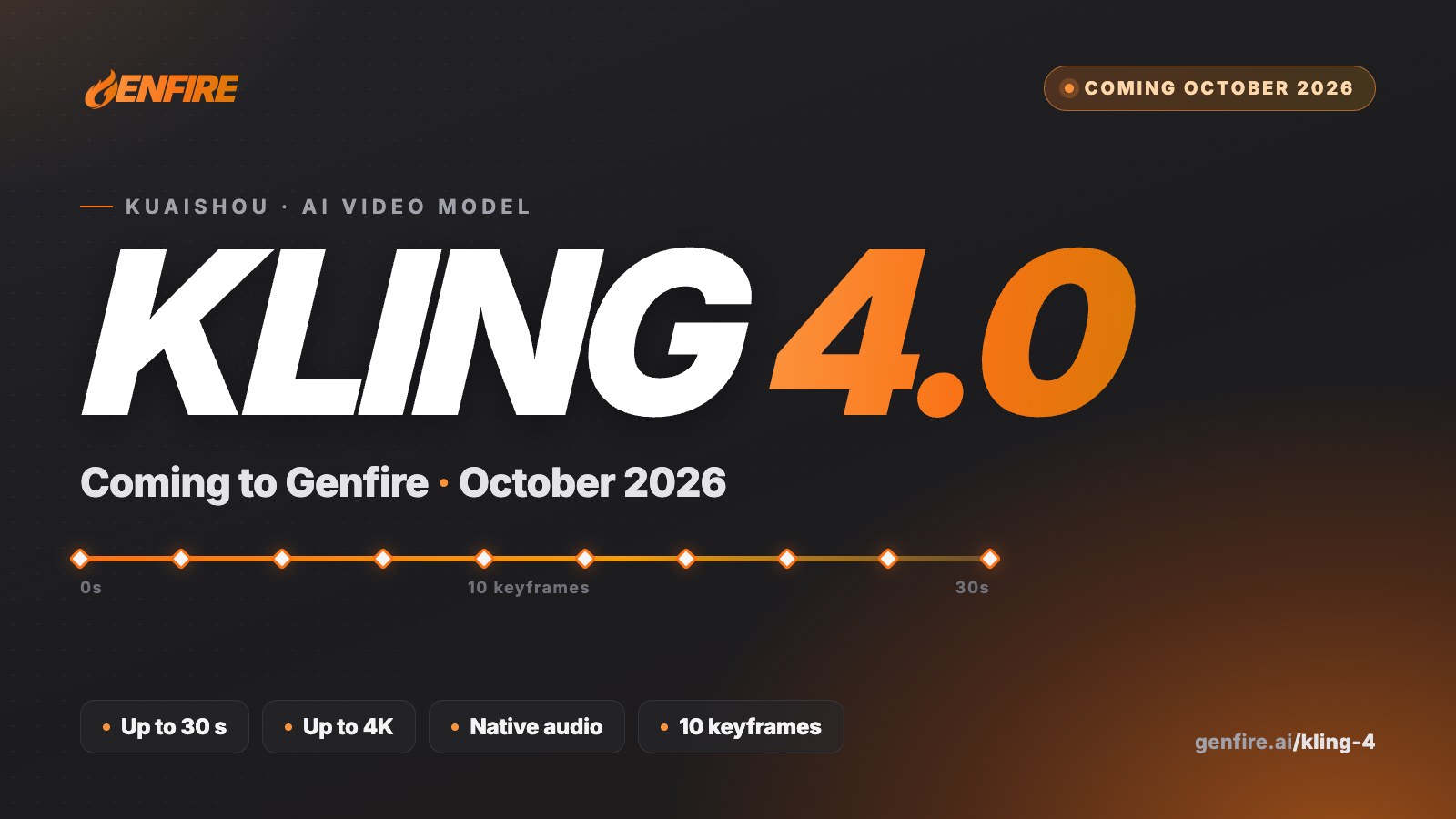
Kling 4.0 is the fourth generation of Kling, the AI video model family built by Kuaishou's Kling AI team. Kling announced it on September 28, 2026 under the line "You call the shots", and the pitch is control: longer single generations, up to 10 keyframes, up to 15 mixed references, native 4K and stereo sound with tighter lip-sync. Kling 4, Kling V4 and Kling AI 4.0 all mean the same model; the official name is Kling 4.0.
It comes in two tiers. Kling 4.0 is the full model. Kling 4.0 Flash is a faster tier capped at 20 seconds and 720p, which Kling describes as "built for frequent creation". Kling hasn't announced Standard, Pro or Master variants for 4.0, and 4K is a resolution setting on Kling 4.0 rather than a separate tier.
Kling 4.0 release date and availability
Kling says the all-new Kling 4.0 "will officially launch in October". It hasn't named a day, so any site quoting an exact date is guessing. Here is what is confirmed as of the date at the top of this page.
| What | Status |
|---|---|
| Announcement | September 28, 2026, in Kling's release notes and on its official X account |
| Kling 4.0 (full model) | Launching in October 2026. No exact day announced |
| Kling 4.0 Flash | Early access since September 28, 2026, for Kling Ultra yearly subscribers in the Kling app |
| Kling API | Not yet. Kling's API pricing page says its plans "currently don't support Kling 4.0" |
| Pricing | Not published: no credit or per-second price from Kling yet |
| 10-bit HDR output | Coming soon, per Kling |
| Video extension (up to 2 minutes) | Coming soon, per Kling |
| On Genfire | Not available yet. We're preparing it and will update this page the day it goes live |
Sources: Kling AI's "Meet All-New Kling 4.0" release note, its release history and API pricing pages, and @Kling_ai on X. We update this table when Kling publishes new details.
Kling 4.0 key features
30 seconds in one generation
Anything from 3 to 30 seconds in a single pass, double Kling 3.0's 15-second ceiling. A long take or a multi-beat scene comes out as one continuous clip instead of stitched pieces.
Up to 4K, with 10-bit HDR coming
Output at 720p, 1080p or 4K. Kling says 10-bit HDR at 1080p and 4K is coming soon, for more highlight and shadow detail and more room to grade. 21:9 ultrawide joins 16:9, 1:1, 9:16 and an Auto setting.
Up to 10 keyframes
Supply up to 10 keyframe images and Kling 4.0 builds the motion between them, so character states, scene changes and story beats land where you place them. First-and-last-frame and single-image starts work too.
Omni Reference: 15 inputs at once
Mix up to 15 references in one generation: up to 10 images, up to 5 videos (30 seconds combined) and up to 7 subjects, 3 of which can be defined from video. A subject can carry a voice reference, so a character keeps its look and its voice.
Stereo audio and sharper lip-sync
Sound is generated with the picture in two-channel stereo, with more accurate lip-sync. Speech covers Chinese, English, Japanese, Korean, Spanish, Portuguese, German, French and more, plus accents and dialects such as British, American and Indian English or Cantonese.
Edits to footage you already have
Feed in up to 5 clips, including one primary video (each 3–30 seconds, 30 seconds combined), and change expressions, movement, camera, background or style while the rest of the scene holds.
Motion and camera from reference video
Reference videos can drive performance, action, camera movement and pacing, including white-model (untextured 3D) and depth-map videos for tighter control. Kling also pitches it for remaking a proven ad's structure with your own product or character.
8,000-token prompts and legible text
Prompts can run to 8,000 tokens, and Kling says the model expands short prompts "with a director's eye". It also renders legible on-screen text in multiple languages, plus emoji and logos, that stays stable as the camera moves.
Kling 4.0 at a glance
Kling 4.0 Flash
Kling 4.0 Flash is the fast tier of the Kling 4.0 lineup, and the only part of it open to Kling users today. It opened on September 28, 2026 as early access for Kling Ultra yearly subscribers, ahead of the full model's October launch. Kling says Flash "combines fast generation with excellent value".
Its published spec is narrower: text-to-video, image-to-video from a first frame, and Omni Reference, at 3 to 20 seconds, 720p only, in 8-bit SDR. Kling's Flash spec sheet doesn't list end frames, multi-keyframes, video editing, audio or aspect ratios, so treat those as unconfirmed for Flash until Kling says otherwise.
Flash suits drafts, iteration and high-volume social cuts where 720p is enough. The full Kling 4.0 is the one for 1080p or 4K deliverables, clips longer than 20 seconds, keyframe-driven sequences and edits to existing footage. If you searched for "Kling 4 Turbo", Flash is the tier you mean: Kling calls its fast 4.0 tier Flash, not Turbo.
Kling 4.0 vs 4.0 Flash vs Kling 3.0 vs 3.0 Turbo
| Kling 4.0 | Kling 4.0 Flash | Kling 3.0 on Genfire | Kling 3.0 Turbo on Genfire | |
|---|---|---|---|---|
| Status | Launching October 2026 | Early access (Kling Ultra yearly) | Live now | Live now |
| Clip length | 3–30 s | 3–20 s | 3–15 s | 3–15 s |
| Resolution | 720p · 1080p · 4K | 720p | Standard · Pro · separate 4K tier | 720p (Standard) · 1080p (Pro) |
| Dynamic range | 10-bit HDR at 1080p/4K (coming soon) | 8-bit SDR | — | — |
| Aspect ratios | 21:9 · 16:9 · 1:1 · 9:16 · Auto | Not listed | 16:9 · 9:16 · 1:1 | 16:9 · 9:16 · 1:1 |
| Frames | First & last frame · up to 10 keyframes | First frame | Start frame · end frame | Start frame |
| References | Up to 15 (10 images, 5 videos, 7 subjects) | Omni Reference (limits not published) | @-mentioned elements | None |
| Audio | Two-channel stereo with lip-sync | Not listed | Generated | None |
| Video editing | Up to 5 clips, 30 s combined | Not listed | No (video-to-video is on Kling O3) | No |
| Prompt length | Up to 8,000 tokens | Not listed | About 2,450 characters | About 2,450 characters |
The Kling 4.0 and Flash columns are Kling's published specs; "Not listed" means Kling's spec sheet doesn't say. The Kling 3.0 columns describe the tiers as they run on Genfire today (Kling V3 and V3 Turbo). "—" means not part of that model's spec.
Kling 4.0 prompts to try at launch
Built to Kling 4.0’s strengths — steal these to get started.
How to use Kling 4.0 on Genfire
- 1
Sign up now
Create a Genfire account so you're ready the moment Kling 4.0 lands. Kling 3.0, 3.0 Turbo and O3 are live today if you want to start with the current generation.
- 2
Pick Kling 4.0 at launch
In the browser video studio, choose Kling 4.0 or Kling 4.0 Flash, add a prompt, keyframes or references, and see the credit cost before you generate.
- 3
Or build on it
Call it from the Genfire API, from any MCP client through the Genfire MCP server, or from the CLI, all on the same credit balance and with no Kling account.
Kling 4.0 vs Kling 3.0: what changed
Length is the headline. Kling 3.0 tops out at 15 seconds per generation; Kling 4.0 doubles that to 30 in a single pass, and Kling says clip extension, up to two minutes across multiple extensions, is coming soon. For long takes and complete short scenes, that is the difference between one generation and a stitched sequence.
Control is the second change. Kling 3.0 gives you a start frame and an end frame; Kling 4.0 takes up to 10 keyframes, so a sequence can be pinned at ten points instead of two. References grow too. Kling 3.0 on Genfire works with @-mentioned elements, while 4.0's Omni Reference combines up to 10 images, 5 videos and 7 subjects in one request, with a voice attached to a subject and reference videos (including white-model and depth-map clips) steering motion and camera.
Output is the third. Kling 4.0 adds 21:9, two-channel stereo sound with more accurate lip-sync, legible multilingual on-screen text, 4K as a standard resolution option and, soon, 10-bit HDR. Prompts can run to 8,000 tokens instead of roughly 2,450 characters. One thing Kling's 4.0 announcement doesn't mention is Motion Control, Kling 3.0's character-animation mode. For that, Kling 3.0 Motion Control is live on Genfire now, as are Kling 3.0 Turbo for fast 3–15 second clips and Kling O3 for reference-to-video and video-to-video work.
Kling 4.0 on the Genfire API, MCP server and CLI
When Kling 4.0 goes live on Genfire, it will sit next to the rest of the Kling family in the browser video studio, the REST API, the MCP server and the command-line tool, all billed from one Genfire credit balance. You won't need a Kling account, a Kling subscription or a separate API key, and purchased credits include Genfire's commercial license.
Kling's own API doesn't support 4.0 yet, and Kling hasn't published a model ID. We plan to expose Kling 4.0 through the same POST /v1/videos/generations endpoint as the other Kling models, with its model ID listed by GET /v1/models, on this page and in the developer docs at launch. Anything you build today against Kling 3.0 (video.kling_v3 and its Turbo, 4K and Motion Control siblings) or Kling O3 runs now.
Kling 4.0 — frequently asked questions
What is Kling 4.0?
Kling 4.0 is Kuaishou's fourth-generation Kling AI video model, announced on September 28, 2026. It generates 3–30 second videos at up to 4K with stereo audio and lip-sync, accepts up to 10 keyframes and up to 15 mixed references, and can edit existing footage. A faster 720p tier, Kling 4.0 Flash, sits alongside it.
When is the Kling 4.0 release date?
Kling says the all-new Kling 4.0 "will officially launch in October" 2026. It has not announced a specific day. Kling 4.0 Flash has been in limited early access since September 28, 2026. We'll update this page when Kling confirms a date.
Is Kling 4.0 out yet?
Not fully. As of September 29, 2026, only Kling 4.0 Flash can be used, and only by Kling Ultra yearly subscribers in the Kling app. The full Kling 4.0 model launches in October, and it isn't on Kling's API or on Genfire yet.
What is the difference between Kling 4.0 and Kling 4.0 Flash?
Kling 4.0 is the full model: 3–30 seconds, 720p to 4K, 10-bit HDR coming soon, up to 10 keyframes, 15 references, stereo audio and video editing. Kling 4.0 Flash is the faster tier: 3–20 seconds at 720p in 8-bit SDR, with text-to-video, first-frame image-to-video and Omni Reference.
Is there a Kling 4 Turbo?
No. Kling's fast tier for this generation is called Kling 4.0 Flash, and "Turbo" doesn't appear in any official Kling 4.0 material. The most recent Turbo model is Kling 3.0 Turbo from June 2026, which runs on Genfire today as Kling V3 Turbo for 3–15 second clips at 720p or 1080p.
Are Kling 4, Kling 4.0 and Kling V4 the same?
Yes. The official name is Kling 4.0, and Kling 4, Kling V4 and Kling AI 4.0 all refer to the same model. The previous generation is Kling 3.0, which Genfire lists as Kling V3.
How long can Kling 4.0 videos be?
Kling 4.0 generates 3 to 30 seconds per generation, and Kling 4.0 Flash 3 to 20 seconds. Kling says a video-extension feature that extends a clip several times, up to 2 minutes in total, is coming soon.
Does Kling 4.0 support 4K and HDR?
Kling 4.0 outputs 720p, 1080p or 4K. Kling lists 10-bit HDR at 1080p and 4K and says it is coming soon. Kling 4.0 Flash is 720p in 8-bit SDR.
Does Kling 4.0 generate audio and lip-sync?
Yes. It generates two-channel stereo audio with the video and more accurate lip-sync than earlier Kling models. Speech covers languages including Chinese, English, Japanese, Korean, Spanish, Portuguese, German and French, with regional accents and dialects. A subject can carry a voice reference so a character keeps the same voice.
How many references and keyframes can Kling 4.0 use?
Up to 10 keyframe images, and up to 15 references in one generation: at most 10 images, 5 videos (30 seconds combined) and 7 subjects, up to 3 of which can be built from video. Subjects can include a voice reference.
Does Kling 4.0 have Motion Control?
Kling's Kling 4.0 announcement doesn't list a Motion Control mode. It does let reference videos, including white-model and depth-map videos, guide motion, performance and camera. If you need Kling's dedicated Motion Control today, Kling 3.0 Motion Control is live on Genfire.
Is Kling 4.0 free?
Not as announced. Kling hasn't published pricing, and early access to Kling 4.0 Flash is limited to its paid Ultra yearly plan. There is no official free Kling 4.0 tier, so treat "free Kling 4.0" offers made before launch with caution. A Genfire account is free to create; Kling 4.0 generations will cost credits, with the price published at launch.
How much will Kling 4.0 cost?
Kling hasn't published a price for Kling 4.0 or Kling 4.0 Flash in its app or its API. Genfire will publish its credit price for Kling 4.0 on this page and in the studio when the model goes live. Genfire is pay-as-you-go: credit packs start at $19, and every purchase includes a commercial license.
Is there a Kling 4.0 API?
Not from Kling yet. Its API pricing page says its plans "currently don't support Kling 4.0", and no 4.0 model ID has been published. When Genfire adds Kling 4.0, it will be available through the Genfire REST API, MCP server and CLI on one credit balance, with no Kling account needed.
When will Kling 4.0 be on Genfire?
We're preparing it now and will turn it on as soon as we can run it reliably, which depends on the model becoming available to us after Kling's October launch. We won't guess a date. Until then, Kling 3.0, Kling 3.0 Turbo and Kling O3 are live on Genfire.
Compare with other models
From the blog
All posts →Explore Genfire
AI Tools
AI Models
Be first to generate with Kling 4.0
Kling 4.0 is coming to Genfire. Sign up now and you'll be ready to generate the moment it goes live — with a full editing, captioning, and export pipeline waiting in the same studio.
Get notified at launch